
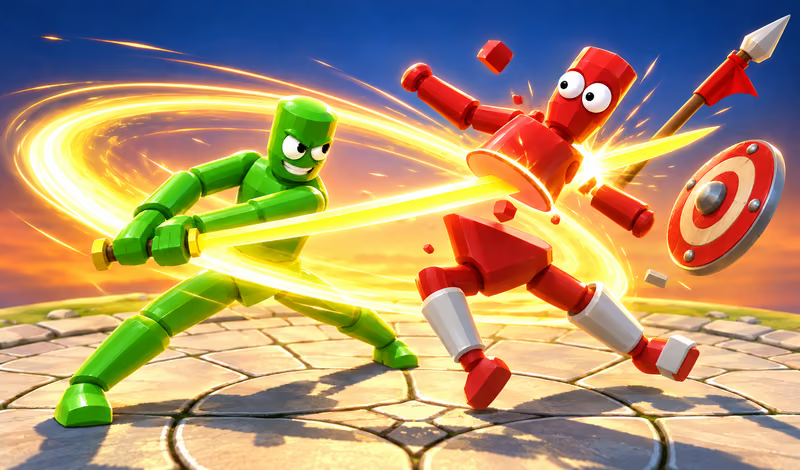








About Ragdoll Duel: Sword Fight
Ragdoll Duel: Sword Fight is an arena fighting game built around mouse-guided movement and loose character physics. You hold and drag the mouse to guide the fighter and its sword. A strong approach can create an opening, but a careless movement can also leave the character off balance.
Encounters become easier to read when you separate the approach from the recovery. Note the distance to the opponent, make a controlled movement, and watch where your fighter ends up after contact. Different arenas and opponents give you new reasons to adjust that spacing.
How to Play Ragdoll Duel: Sword Fight
Guide your fighter toward an opponent, use movement to bring the sword into position, and recover after each exchange.
- Observe the opponent and the available space in the arena.
- Hold and drag the mouse to move your fighter.
- Adjust the direction and timing of the movement to bring the sword toward the opponent.
- Watch your character's position after contact and recover before advancing again.
- Adapt the approach to the next encounter or arena.
Controls & Timing
Movement creates the swing
Hold and drag the mouse to move and swing the sword. Start with a small drag to learn how the fighter responds before committing to a long approach.
Recovery creates the next opening
After contact, the fighter may turn or lose balance. Read the new position and the opponent's distance before deciding whether another forward movement is useful.
Controls
| Input | Action | When to use |
|---|---|---|
| Hold and drag mouse | Move the fighter and guide sword swings | Approach, position, or respond during an exchange. |
High Score Tips
- Measure the opening distance. Give yourself enough room to see how a short drag affects the fighter before moving into contact.
- Approach with a recovery route. A swing can leave the character moving past the opponent. Consider where that motion may end before committing.
- Watch the opponent's weapon. When the opponent's weapon moves aside, look for a chance to strike instead of dragging forward continuously.
- Inspect a new arena. Moving elements and hazards can change the space available for a duel. Identify them before reusing the previous route.
- Adjust one movement at a time. Compare a shorter drag with a longer one in a familiar situation to learn how momentum changes the exchange.
Key Features
- Mouse-guided duels: Control movement and sword swings with a drag.
- Ragdoll physics: Fighters can stumble or rotate after contact.
- Spacing decisions: Distance influences the approach and recovery.
- Different arenas: Watch for hazards and moving elements.
- Sequential encounters: Adapt to the opponents presented by the game.
Frequently Asked Questions
How do I move and swing?
Hold and drag the mouse to guide both the fighter and the sword. Begin with a small movement to learn the response.
Why does my fighter lose balance?
Loose ragdoll physics affect movement after a clash. Watch the fighter's new position before deciding whether to move toward the opponent again.
What should I check in a new arena?
Look for the space around the fighter, the opponent's starting position, and any moving elements or hazards. These can change the route that is available.
How can I improve an unsuccessful swing?
Compare the distance and direction of your drag with the opponent's position. Try changing one of those decisions in a similar encounter and observe the result.